Overview of Dremel 4000
Dremel 4000 is a rotary tool with a cord, four attachments, and thirty-four accessories. An effective ventilation system makes the workspace conducive and prevents heat. That is why the Dremel tool has managed to be noise-free and smooth.
The storage case protects your tool from damage. Dremel 4000 comes with electronic feedback control that informs you when something is not working. That includes speed and too much pressure. If your grinding becomes too hard, you get a signal.



You have control over what happens with the rotary tool. Dremel 4000 introduces a speed dial feature that you easily turn on and off. You are allowed to change the speed even when you are operating the rotary tool without stopping it. That gives the rotary tool great performance.
With a beautiful ergonomic design, the separate speed controls are handy when completing your tasks. You do not have to strain yourself when using the tool. It feels comfortable and comes with a cord that connects to the power.
Dremel 4000 comes with better attachments, although it allows some dust to get inside the rotary tool. I urge you to use compressed air to get rid of the particles. The rotary tool is solid and durable. In case of an accident, it does not break easily.
The rotary tool is ideal for professionals, and it is user-friendly. The tool combines practicality and technology, and the motor brings out top performance. There is a balance between power and ease of manipulation.
Compatibility is one of the strengths of the rotary tool. The rubber grip makes the operation comfortable, and holding the rotary tool in your way makes you comfortable. You have no fear of having the tool slipping off your hands. It comes with more accessories that it works with.
Advantages of the Dremel 4000
- Versatile
- Innovated airflow system
- High-performance motor
- Numerous accessories
- Ergonomic design
- Ease of use
- Affordable
Disadvantages of the Dremel 4000
- The dust collection system could have been better
- It could have been lighter
Features of the Dremel 4000
Speed dial
The speed dial assists you in controlling and monitoring speed. The dial is in an area that does not disturb your operation. It is far from the handle. A separate On/Off switch makes the Dremel tool easy to use.
Motor
The motor is strong enough to deliver top performance at all speeds. The speed varies from 5,000 to 35,000 rpm. It consists of an electronic feedback circuitry with notifications when a fault or the rotary tool is at risk. This allows consistency in performance even on tough tasks.
Grip
Dremel 4000 has a slim and ergonomic body. The 360-degree grip zone gives you more comfort, and that extends usage.
Proxxon 28481
Proxxon 28481 is a powerful tool for polishing, grinding, milling, and drilling. This rotary tool is equipped with an advanced motor for handling different tasks. It feels well built. The switches are nice, and the metal and plastic have a heavy-quality feel. This underscores its efficiency.
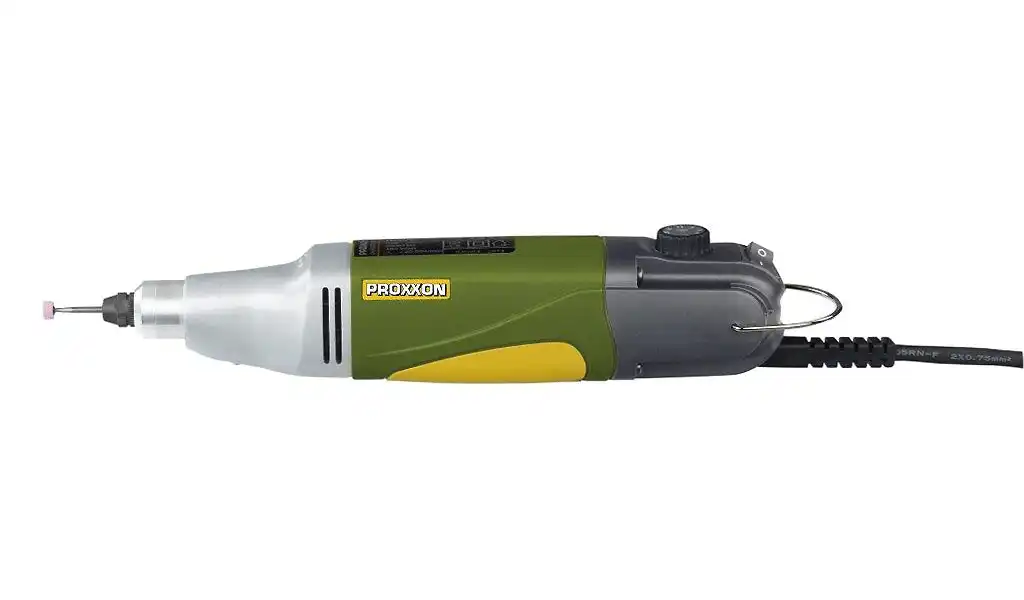
The unit is quieter than the Dremel and more powerful. The rotary tool does not require changing brushes and has comprehensive electronic speed control. The electronic controls ensure the rotary tool delivers consistent performance. This feature helps you get enough torque when you use it.
The Proxxon produces torque even when running at low speeds, making it ideal for polishing and brushing sensitive objects. The motor is finely balanced and reduces the chances of overheating.
The 28481 is also free of vibrations, allowing you to operate comfortably. The power tool has an ergonomic design, so your hand does not get tired. When you feel like changing the bit, use the button lock spindle.
The stable gear head is made of die-cast aluminum. That is a more convenient method than other rotary tools, and the ball bearing makes the unit easier to work with. It has a keyless chuck. You can use it with 1/64 to 1/8 inches shanks.
Advantages of the Proxxon 28481
- Compatibility
- Durability
- Comfortable
- Many accessories
- Powerful motor
- Speed variance
- Noise-free
Disadvantages of the Proxxon 28481
- It could have been an all-round rotary tool
- More power could do
Features
Ball-bearing spindle
It has a ball-bearing ground steel spindle with a lock button for rapid cutter changing. The streamlined head of die-cast aluminum is for exact bearing seats and optimal stability.
Motor
It has a quiet, powerful 100W motor with full-wave electronics for speeds between 5,000 and 20,000rpm. It is high-speed with a balanced DC motor and an adjustable electronic speed regulator.
Accessories
It features 34 bits and cutters of industrial quality, all shafts Ø 2.35mm. Complete with six triple slit steel collets covering 1.0 to 3.2mm.
Power
The Dremel 4000 is more powerful than Proxxon as it offers more speed options.
Cost
Dremel comes with a wide range of tools at different prices, from low to high end. You have fewer options when it comes to Proxxon.
Accessories
Both rotary tools have multiple accessories, but Demel comes with more. It is also more compatible with Dremel accessories.
Uses
The built-in features make the Proxxon and Dremel rotary tools suitable for different tasks. The Dremel 4000 series is a rotary tool for home and on-site use. It is more powerful and offers more options for speeds. The Proxxon rotary tools, however, are for intricate, detailed work. The Dremel rotary tools are ergonomic, well balanced, and built for long-term use.
Dremel 4000 vs Proxxon, which is better?
The better tool depends on what you need. Dremel rotary tools are more powerful and suitable for home and onsite use. Proxxon tools, on the other hand, are not as powerful but can meet the needs of homeowners and DIY buffs. For professionals, you may want to check out the Dremel 4000 instead.
Dremel 4300 vs Proxxon, which is better?
Dremel is better than Proxxon in terms of what it offers. It features a high-performance motor that delivers top performance in the most demanding applications. The variable speed of 5,000 – 35,000 RPM with electronic feedback gives consistent performance and accurate tool control.
Proxxon tools that are similar to Dremel ones
Proxxon 28512 12-Volt Micromot 50 EF Rotary Tool
The 28512 is one of the more versatile tools Dremel has. That is a compact rotary tool for those who do not need a fancy utility. Even if it is 1 1/2 lbs and 11.5 inches wide, the 28512 is for multiple light to medium tasks and projects.
It features a DC motor that is powerful but quiet, thereby suiting long-term use. Its chuck is well-designed and lasts longer. It uses a keyless chuck and variable speed and handles any task. It also works with different shafts ranging from 1/32 to 1/8 inches.


The Proxxon 28512 works better when used with different HS drill bits. No matter what size you are working with, it is easy because the tool is light and easy to use. The 28512 is of polyamide fortified with fiber. The handle is balanced, soft, and comfortable to hold.
It does not come with an on/off switch. You must plug it into the Proxxon supply and turn it on and off. Maximum performance is what you get from the model. The speed control does not disappoint. Unlike other rotary tools, it does not overheat.
Features
- Fibre enhanced body
- A powerful and low noise motor
- Electronic feedback
- Rapid action chuck
- Light and easy to carry
Proxxon 38472 FBS 115/E Precision Rotary Tool
The Proxxon 38472 is a specific model that comes with consistency. It is a versatile rotary tool for cutting, carving, engraving, de-rusting, and deburring. The 38472 is also for polishing, grinding, milling, and drilling. The rotary tool features an advanced motor for handling different tasks.
The 38472 does not require changing brushes and has comprehensive electronic speed control. The electronic controls ensure the tool stays consistent in delivering performance. The feature helps you get sufficient torque when you use it.


The 38472 Proxxon produces torque even when operating at low speeds, making it ideal for polishing and brushing sensitive objects. The motor is balanced and reduces the chances of overheating. The 38472 is vibration-free, and that helps you work in comfort.
The 38472 features an ergonomic design, reducing the chances of getting tired while using it. If you wish to change the bit, use the button lock spindle. That is a more convenient method compared to others used by rotary tools.
The ball bearing also makes the unit easier to work with and features a keyless chuck so you can use it with 1/64 to 1/8-inch shanks.
Features
- 40 accessories
- Works with the Proxxon 28610 bench clamp holder
- Compatible with the 28405 adapter
- A soft grip for comfortable handling
- Storage case for the accessories
Proxxon 38481 Professional Rotary Tool IBS/E
Proxxon 38481 Professional Rotary Tool IBS/EThe Proxxon 38481 is highly efficient. The 38481 tips the scale at 1.3 lbs and is 9 inches long. It packs 1/8 horsepower to carry out multiple tasks.
The 38481 has a speed variance ranging from 5,000 to 20,000 RPM, meaning it is more than capable of meeting your requirements. These specs have a powerful motor that can handle a lot of projects.


The specs are so powerful that the 38481 is one of the best options for engraving, grinding, cutting, cleaning and polishing. You also get 34 cutters and bits designed for industrial use. It is ideal for people using the six collets, 1/8, 7/64, 3/3-2, 5/64, 1/16, and 1/32 inches.
When it comes to performance, the 38481 is smooth. The variable speed allows you to use it for professional and hobby projects. You can run the 38481 at high torque without feeling vibrations or a performance dip. The rotary tool is also light, allowing optimum results at high torque.
A storage case is provided, and you can store the 34 accessory pieces, including half a dozen triple slit collets.
Features
- Half a dozen steel collets
- Weighs 1.3 lbs
- Powerful motor
- 5-20,000 RPM
- 1/8 HP
Where are Proxxon tools made?
The Proxxon tools are manufactured in China.
Price comparison
Dremel comes with a wide range of tools at different prices, from low to high-end. You have fewer options when it comes to Proxxon.
Warranty Comparison
Proxxon offers a limited 2-year warranty, while Dremel gives a 2-year warranty against defective material. It becomes valid from the date of purchase. No other person is authorized to give any warranties on behalf of Dremel.
Suppose Dremel’s inspection shows that problems with materials within the limitations of the warranty caused the problem. In that case, Dremel will repair or replace the product free of charge and return the product.
Is Proxxon a good brand?
Yes. Proxxon rotary tools operate quietly, even at maximum speed, and the rotary tools are better balanced. It comes with accessories and bits of good quality, and it is better than Dremel regarding precision work.
It does not overheat as quickly as other rotary tools and features six collets of varying sizes. Dremel tools need a flex shaft for delicate carving. You can buy these easily enough, but that is an added expense, whereas Proxxon has it free.
Does Proxxon make good tools?
Yes, it does. It offers high-quality fine power tools for model makers, precision mechanics, opticians, and premium hand tools for professional use. They are well-built, and the switches are nice. The metal and plastic have a heavy-quality feel.
Are Proxxon rotary tools better than Dremel’s
When it comes to comfort and precision, Proxxon is better than Dremel. However, Dremel offers more than Proxxon. The Dremel has a greater RPM speed than the Proxxon, and its amperage is higher than a Proxxon rotary tool.
More kits are available, and the Dremel is a better all-around rotary tool, unlike the Proxxon. It features a speed circuitry control to counter overload and is compatible with all Dremel attachments and accessories.
Dremel rotary tools have RPM greater than 20,000 RPM. You get more flexibility, versatility, and strength compared to the Proxxon. The Dremel rotary tools last longer if used heavily.
Proxxon tools that are similar to Dremel ones
Proxxon 28512 12-Volt Micromot 50 EF Rotary Tool
The 28512 is one of the more versatile tools Dremel has. That is a compact rotary tool for those who do not need a fancy utility. Even if it is 1 1/2 lbs and 11.5 inches wide, the 28512 is for multiple light to medium tasks and projects.
It features a DC motor that is powerful but quiet, thereby suiting long-term use. Its chuck is well-designed and lasts longer. It uses a keyless chuck and variable speed and handles any task. It also works with different shafts ranging from 1/32 to 1/8 inches.
The Proxxon 28512 works better when used with different HS drill bits. No matter what size you are working with, it is easy because the tool is light and easy to use. The 28512 is of polyamide fortified with fiber. The handle is balanced, soft, and comfortable to hold.
It does not come with an on/off switch. You must plug it into the Proxxon supply and turn it on and off. Maximum performance is what you get from the model. The speed control does not disappoint. Unlike other rotary tools, it does not overheat.
Features
- Fibre enhanced body
- A powerful and low noise motor
- Electronic feedback
- Rapid action chuck
- Light and easy to carry
Proxxon 38472 FBS 115/E Precision Rotary Tool
The Proxxon 38472 is a specific model that comes with consistency. It is a versatile rotary tool for cutting, carving, engraving, de-rusting, and deburring. The 38472 is also for polishing, grinding, milling, and drilling. The rotary tool features an advanced motor for handling different tasks.
The 38472 does not require changing brushes and has comprehensive electronic speed control. The electronic controls ensure the tool stays consistent in delivering performance. The feature helps you get sufficient torque when you use it.
The 38472 Proxxon produces torque even when operating at low speeds, making it ideal for polishing and brushing sensitive objects. The motor is balanced and reduces the chances of overheating. The 38472 is vibration-free, and that helps you work in comfort.
The 38472 features an ergonomic design, reducing the chances of getting tired while using it. If you wish to change the bit, use the button lock spindle. That is a more convenient method compared to others used by rotary tools.
The ball bearing also makes the unit easier to work with and features a keyless chuck so that you can use it with 1/64 to 1/8-inch shanks.
Features
- 40 accessories
- Works with the Proxxon 28610 bench clamp holder
- Compatible with the 28405 adapter
- A soft grip for comfortable handling
- Storage case for the accessories
Proxxon 38481 Professional Rotary Tool IBS/E
Proxxon 38481 Professional Rotary Tool IBS/EThe Proxxon 38481 is highly efficient. The 38481 tips the scale at 1.3 lbs and is 9 inches long. It packs 1/8 horsepower to carry out multiple tasks.
The 38481 has a speed variance ranging from 5,000 to 20,000 RPM, meaning it is more than capable of meeting your requirements. These specs have a powerful motor that can handle a lot of projects.
The specs are so powerful that the Proxxon 38481 is one of the best options for engraving, grinding, cutting, cleaning and polishing. You also get 34 cutters and bits designed for industrial use. It is ideal for people using the six collets, 1/8, 7/64, 3/3-2, 5/64, 1/16, and 1/32 inches.
When it comes to performance, the 38481 is smooth. The variable speed allows you to use it for professional and hobby projects. You can run the 38481 at high torque without feeling vibrations or a performance dip. The rotary tool is also light, allowing optimum results at high torque.
A storage case is provided, and you can store the 34 accessory pieces, including half a dozen triple slit collets.
Features
- Half a dozen steel collets
- Weighs 1.3 lbs
- Powerful motor
- 5-20,000 RPM
- 1/8 HP

- Grain and Sheen: Teak Oil versus Danish Oil Uncovered - January 10, 2024
- The Cherry on Top: Crafting the Perfect Cutting Board - January 9, 2024
- Polyurethane Water-Based vs Oil-Based: Choosing the Right Finish - January 8, 2024
