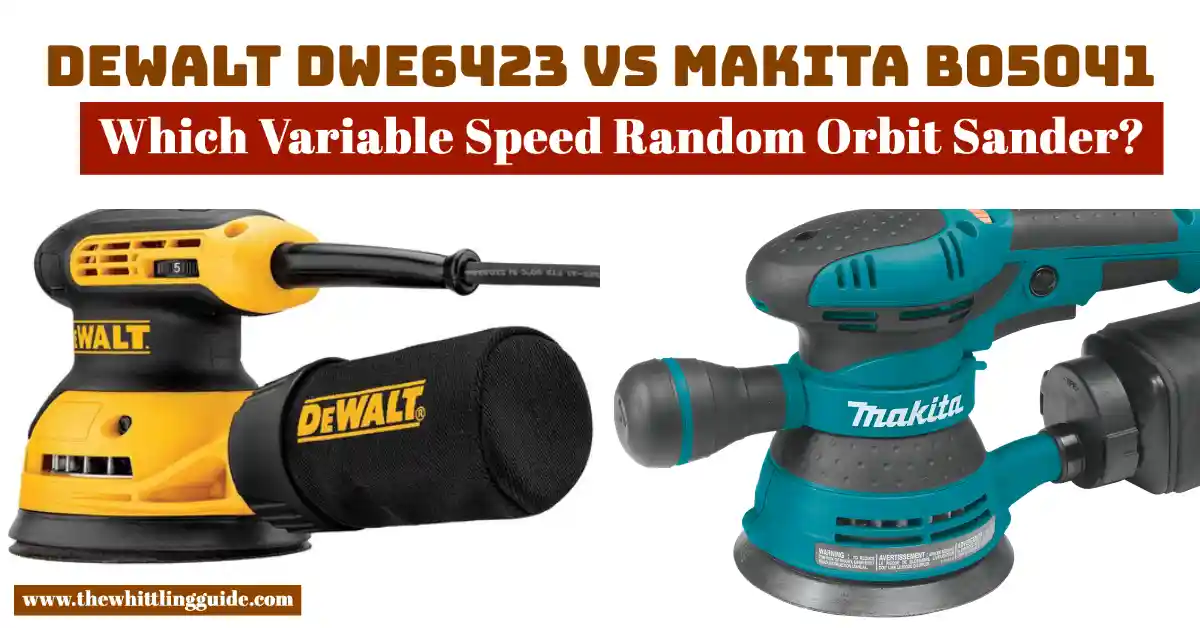
The DeWalt DWE6423 and Makita BO5041 are both 5-inch random orbital sanders, but they are not the same kind of buy. The DeWalt is the simpler, lower-profile, better-value choice for most DIY users and general woodworking. The Makita is the better pick if you want more control, a front handle, and a lower speed range for delicate sanding.
Quick verdict: buy the DeWalt DWE6423 if you want a compact, easy-to-handle sander for regular furniture, trim, deck, and workshop sanding. Buy the Makita BO5041 if you sand for longer sessions, want two-handed control, or need to slow the tool down more for heat-sensitive materials, finishes, plastics, or delicate surfaces.
DeWalt DWE6423 vs Makita BO5041: Fast Comparison
| Feature | DeWalt DWE6423 | Makita BO5041 | What it means |
|---|---|---|---|
| Type | 5-inch random orbital sander | 5-inch random orbital sander | Both use common hook-and-loop sanding discs. |
| Power | 3 amp / 280 W, depending on market | 3 amp / 300 W, depending on market | Power is close enough that ergonomics and control matter more. |
| Speed range | 8,000–12,000 OPM | 4,000–12,000 OPM | Makita has the wider low-speed range. |
| Grip style | Compact palm grip | Palm grip plus removable rotating front handle | Makita gives more hand positions; DeWalt feels simpler and lower. |
| Dust collection | One-handed locking dust bag; compatible with DeWalt dust extractors | Dust bag; small dust port may need an adapter for shop vac use | DeWalt is easier if you already use DeWalt extraction gear. |
| Best for | General sanding, DIY use, value buyers | Control, longer sessions, lower-speed sanding | The choice depends more on handling than raw power. |
Best Choice by User Type
| You need… | Better pick | Why |
|---|---|---|
| Best value for normal woodworking | DeWalt DWE6423 | It has enough power, variable speed, a compact body, and usually costs less. |
| Better low-speed control | Makita BO5041 | Its 4,000–12,000 OPM range gives more control at the bottom end. |
| Two-handed sanding | Makita BO5041 | The removable front handle makes it easier to guide the sander on large or awkward surfaces. |
| A lower, compact feel | DeWalt DWE6423 | The shorter body lets your hand sit closer to the workpiece. |
| Dust extractor compatibility | DeWalt DWE6423 | DeWalt specifically supports connection to compatible DeWalt dust collectors. |
| Extended sanding sessions | Makita BO5041 | The extra handle gives more grip options and can reduce fatigue from holding one position. |
What the Official Specs Say
The official DeWalt DWE6423 product page lists a 3 amp motor, 8,000–12,000 OPM speed range, hook-and-loop pad, separate counterweight, rubber overmold grip, and dust-bag or dust-collector connection. The UK DeWalt listing gives the motor as 280 W.
The official Makita BO5041 product page lists a 3 amp motor, 4,000–12,000 OPM variable speed, two-finger trigger switch, lock-on button, oversized sealed ball-bearing construction, and a front handle that can rotate for better control. The Makita UK listing gives the motor as 300 W and the pad diameter as 125 mm.
The headline difference is not power. It is control range and grip style. The Makita runs much slower at its lowest setting. The DeWalt starts higher, which is fine for most wood sanding but gives less room when you want to reduce heat, soften the cut, or work carefully near edges.
Speed Range: Why 4,000 OPM vs 8,000 OPM Matters
The DeWalt DWE6423 runs from 8,000 to 12,000 orbits per minute. The Makita BO5041 runs from 4,000 to 12,000 orbits per minute. On paper, both reach the same top speed. In use, the Makita gives you twice as much low-speed range.
That matters when sanding surfaces where heat or aggressiveness can become a problem. Lower speeds can help when working on painted surfaces, veneers, plastics, fillers, resin, or final finishing passes where you want more control and less heat build-up. For ordinary wood sanding, many users will still run either sander near the top of its range.
A useful way to think about it is this: the DeWalt is tuned for normal sanding work; the Makita gives you more room to back off.
Grip and Comfort
DeWalt DWE6423 Grip

The DeWalt has a compact palm-grip body. The short height is one of its biggest advantages. Your hand sits close to the work surface, which makes the tool feel stable and easy to steer. This is especially useful for beginners because a tall sander can feel like it wants to tip or skate when it catches an edge.
DeWalt also uses a rubber overmold grip and a separate counterweight to reduce vibration. The tool feels more controlled than cheaper sanders that bounce, chatter, or leave uneven marks when pressure is not perfectly centred.
Makita BO5041 Grip

The Makita BO5041 has the more flexible grip setup. You can hold it from the top like a normal palm sander, use the rear trigger grip, or add the front handle for two-handed control. The front handle rotates and can also be removed.
That handle looks unusual if you are used to basic palm sanders, but it is one of the Makita’s best features. It gives you more control over pitch and yaw, especially on wide boards, cabinet doors, table tops, and vertical surfaces. It also gives your hands more positions during long sanding sessions, which helps reduce fatigue.
The trade-off is size. The Makita feels taller and more tool-like. Some users like that because it gives them leverage. Others prefer the DeWalt because it feels smaller, lower, and easier to palm.
Vibration: The Less Obvious Difference
Vibration is not just comfort. It affects control, finish quality, and how long you can sand before your hands feel tired. A random orbital sander that vibrates too much can encourage you to press harder, grip tighter, or lift one edge without noticing. That is how swirl marks, uneven sanding, and small gouges happen.
The DeWalt DWE6423 has a separate counterweight, which is designed to reduce vibration. In practical terms, this helps it feel smoother than many cheaper sanders. It also stops quickly enough after switch-off that you are less likely to set it down while the pad is still moving.
The Makita BO5041 is also comfortable, but its low-speed behaviour is worth understanding. Some users notice that the tool can feel more visibly “wobbly” at low settings. That does not automatically mean the tool is worse. At lower frequency, your hand can feel more displacement. At higher speeds, the motion can feel smoother even if the acceleration is still there. This is why a sander may feel rougher at speed 1 than speed 5, even though it is doing less cutting work.
For most wood sanding, both tools are comfortable enough. If you are very sensitive to vibration, the DeWalt’s compact palm feel may be easier. If hand position variety matters more, the Makita’s front handle has the advantage.
Dust Collection
Dust collection is one of the most important parts of using a random orbital sander. It keeps the abrasive cutting cleanly, reduces airborne dust, and helps prevent dust from sitting between the disc and the wood, where it can contribute to scratch patterns.
DeWalt DWE6423 Dust Collection
The DeWalt uses a one-handed locking dust bag and can connect to compatible DeWalt dust collectors such as the DWV010 and DWV012. This makes it the easier choice if you already use DeWalt extraction equipment.
The dust bag works better than the bags on many bargain sanders, but a bag is still not the same as a proper shop vacuum or extractor. For indoor sanding, fine dust control matters. Use the sander with extraction where possible, and wear a respirator when sanding wood, paint, filler, or unknown old finishes.
Makita BO5041 Dust Collection
The Makita BO5041 also collects dust through the holes in the sanding disc and into a dust bag. The bag can fill quickly when you are removing a lot of material. Empty it before it is packed full, because an overfilled bag reduces airflow.
The small dust port is one inconvenience. Some users make or buy adapters to connect it to a shop vacuum. A simple adapter can work well, but it is not as plug-and-play as the DeWalt if you are already in the DeWalt dust-extractor system.
Sanding Discs and Pad Compatibility
Both sanders use common 5-inch hook-and-loop sanding discs. That is good news. You are not locked into an odd abrasive size, and you can find discs from many brands in common grits such as 60, 80, 120, 150, 180, 220, and 320.
For both tools, line up the holes in the abrasive disc with the holes in the pad. Those holes are not decoration. They allow dust to move through the pad and into the dust system. If the holes are misaligned, dust collection gets worse and the paper can clog faster.
If the sanding pad loses grip and starts throwing discs, check whether the backing pad is worn before blaming the whole sander. Hook-and-loop pads are consumable parts. Replacing a pad is usually cheaper than replacing the tool.
Performance on Wood
For regular woodworking, both sanders have enough power. They can smooth boards, prep furniture, sand cabinet parts, clean up trim, remove old finish, and prepare surfaces before oil, stain, paint, or varnish.
The DeWalt is the better everyday recommendation because it is compact, easy to guide, and has enough speed for normal sanding. It makes sense if you mostly sand pine, plywood, hardwood boards, painted trim, or DIY furniture parts.
The Makita is better when you want more steering control. The front handle helps when sanding larger flat areas because you can guide the tool with both hands instead of gripping tightly with one. It is also useful when sanding vertical panels or working at awkward angles.
Neither sander is a replacement for a belt sander. If you need to flatten a badly cupped board, remove heavy stock fast, or strip a large deck aggressively, a random orbital sander will be slower. Use these tools for controlled sanding and finishing, not brute-force flattening.
Finish Quality and Swirl Marks
Swirl marks usually come from technique, not just the tool. Pressing too hard, using clogged paper, skipping too many grits, moving too fast, or tilting the sander can all leave marks.
Use either sander like this:
- Start with the right grit. Do not begin with 220 grit if the surface still needs shaping.
- Let the sander’s weight do the work. Do not force it down.
- Move slowly and evenly across the grain direction.
- Overlap passes.
- Vacuum between grits.
- Do not skip from very coarse to very fine paper.
- Keep the pad flat before starting and stopping.
A practical grit sequence for furniture might be 80 → 120 → 180 → 220, depending on the wood and finish. For already smooth timber, you may start at 120 or 150. For finish sanding before oil, 180 or 220 is often enough. Going too fine can sometimes reduce stain absorption.
Where the DeWalt DWE6423 Wins
- Better value for most users: It usually gives more than enough performance for less money.
- Lower profile: The compact body feels close to the workpiece and easy to control.
- Simple palm grip: Good for beginners and quick jobs.
- Good vibration control: The separate counterweight helps make the tool feel smoother.
- Dust system compatibility: It is easier to pair with compatible DeWalt dust extractors.
Where the Makita BO5041 Wins
- Wider speed range: 4,000–12,000 OPM gives more low-speed flexibility.
- Front handle: Better two-handed control for large panels and longer sessions.
- Multiple grip positions: You can change how you hold it as your hands get tired.
- Good for controlled finishing: The lower speed range helps when you want a gentler touch.
- Removable handle: You can use it more like a normal palm sander when needed.
Real-World Buying Advice
Choose the DeWalt DWE6423 if…
- You want the best value.
- You are a beginner buying your first good random orbital sander.
- You prefer a smaller, lower-profile tool.
- You mostly sand wood, furniture, trim, plywood, or DIY projects.
- You already use DeWalt dust extraction.
- You do not need very low-speed sanding.
Choose the Makita BO5041 if…
- You want more control from the lower 4,000 OPM setting.
- You like using two hands on the sander.
- You sand for long periods and want more grip positions.
- You work on furniture, cabinet doors, table tops, or vertical surfaces.
- You sand heat-sensitive materials or finishes.
- You do not mind paying more for ergonomics.
Skip both if…
- You need to flatten slabs or remove heavy material quickly. Use a belt sander, planer, or more aggressive tool.
- You want cordless convenience above all else.
- You need professional-grade dust extraction for daily shop use and are considering premium systems from brands such as Festool or Mirka.
- You only need to sand tiny areas occasionally and can do it by hand.
Project-Based Recommendations
| Project | Better pick | Reason |
|---|---|---|
| General DIY furniture | DeWalt DWE6423 | Compact, affordable, and powerful enough for normal sanding. |
| Cabinet doors | Makita BO5041 | The front handle helps keep the pad flat over wider panels. |
| Deck touch-ups | DeWalt DWE6423 | Good value, but use coarse discs and expect slow progress on rough decking. |
| Painted trim | Makita BO5041 | The lower speed range helps reduce heat and gives more control. |
| Long sanding sessions | Makita BO5041 | More hand positions reduce fatigue. |
| Beginner workshop use | DeWalt DWE6423 | Simple, compact, and easier to justify on price. |
Dust and Safety Notes
Do not treat the dust bag as your only protection. Sanding produces fine dust, and some dust is more hazardous than it looks. Hardwood dust, painted surfaces, old finishes, fillers, and composite boards all deserve care.
Use a respirator, eye protection, and extraction where possible. The UK Health and Safety Executive guidance on wood dust explains why woodworking dust should be controlled rather than ignored. Even in a small home shop, dust control is not optional if you sand often.
Maintenance Tips for Both Sanders
- Empty the dust bag often. A full bag reduces airflow and dust pickup.
- Clean the pad. Dust and resin can reduce hook-and-loop grip.
- Replace worn sanding pads. If discs no longer stick well, the pad may be worn out.
- Do not press too hard. Pressure slows the pad, increases heat, and can cause swirl marks.
- Use fresh abrasives. Dull paper creates heat and makes you push harder.
- Store the tool without crushing the pad. A deformed pad can affect sanding quality.
Which One Is Better for Beginners?
The DeWalt DWE6423 is the better beginner choice. It is compact, straightforward, and less fussy. You get variable speed, decent dust collection, comfortable grip, and enough power without paying extra for a front-handle design you may not need.
The Makita is not difficult to use, but it makes more sense once you understand why you want the extra handle and lower speed range. If you already know you will sand large panels, cabinets, doors, or awkward workpieces, the Makita is still beginner-friendly. It is just not the cheapest route into good sanding.
Which One Is Better for Furniture Making?
For furniture making, the answer depends on the kind of furniture. For small shelves, boxes, side tables, pine projects, and general DIY furniture, the DeWalt is enough. For larger table tops, hardwood panels, cabinet doors, and longer finishing sessions, the Makita’s two-handed control is useful.
If you build furniture often, the Makita BO5041 has the better ergonomic argument. If you build occasionally and want one good sander that does not cost too much, the DeWalt DWE6423 is the smarter buy.
Which One Has Better Dust Collection?
The DeWalt has the edge for plug-and-play dust extraction, especially if you use compatible DeWalt dust collectors. The Makita’s dust collection is still useful, but its small dust port may require an adapter if you want to connect it cleanly to a shop vac.
With either tool, dust collection depends heavily on the disc holes being aligned with the pad holes. Good abrasive discs also matter. Cheap paper that clogs quickly will make any sander feel worse.
Which One Is Better Value?
The DeWalt DWE6423 is usually better value. It gives most users what they actually need: variable speed, a common 5-inch pad, good comfort, a compact body, and enough power for normal sanding.
The Makita BO5041 is worth paying more for if you will actually use the extra control. The front handle and lower speed range are not gimmicks. They are useful. But if you mostly sand wood at medium to high speed, the DeWalt gets you close enough for less money.
Final Verdict
Buy the DeWalt DWE6423 if you want the best all-round 5-inch random orbital sander for general DIY and woodworking. It is compact, comfortable, powerful enough, and usually the better value.
Buy the Makita BO5041 if you want more control, a wider speed range, and the stability of a removable front handle. It is the better choice for longer sanding sessions, larger panels, and users who care more about handling than price.
For most readers, the DeWalt DWE6423 is the sensible choice. For users who sand often and want the extra control, the Makita BO5041 is the nicer tool to live with.
Frequently Asked Questions
Is the DeWalt DWE6423 good for woodworking?
Yes. The DeWalt DWE6423 is a strong choice for general woodworking, furniture sanding, trim, plywood, and painted surfaces. It is not meant for heavy stock removal, but it is very capable as a finish and prep sander.
Is the Makita BO5041 better than the DeWalt DWE6423?
The Makita BO5041 is better for control because it has a wider 4,000–12,000 OPM speed range and a removable front handle. The DeWalt DWE6423 is better value for most users because it is compact, comfortable, and powerful enough for normal sanding.
Can these sanders connect to a shop vac?
Yes, but the ease of connection depends on your hose and adapter. The DeWalt is easier if you use compatible DeWalt dust extraction. The Makita can also be adapted, but its small dust port may require a separate adapter or homemade solution.
Do both sanders use standard sanding discs?
Yes. Both use common 5-inch hook-and-loop sanding discs. Make sure the dust holes line up with the pad holes for proper dust collection.
Which sander is better for long sessions?
The Makita BO5041 is usually better for long sessions because the front handle gives you more ways to hold the tool. The DeWalt DWE6423 is still comfortable, but it has fewer grip options.
Which one should a beginner buy?
Most beginners should buy the DeWalt DWE6423. It is compact, simple, and good value. Beginners who already know they want two-handed control or lower-speed sanding should consider the Makita BO5041.