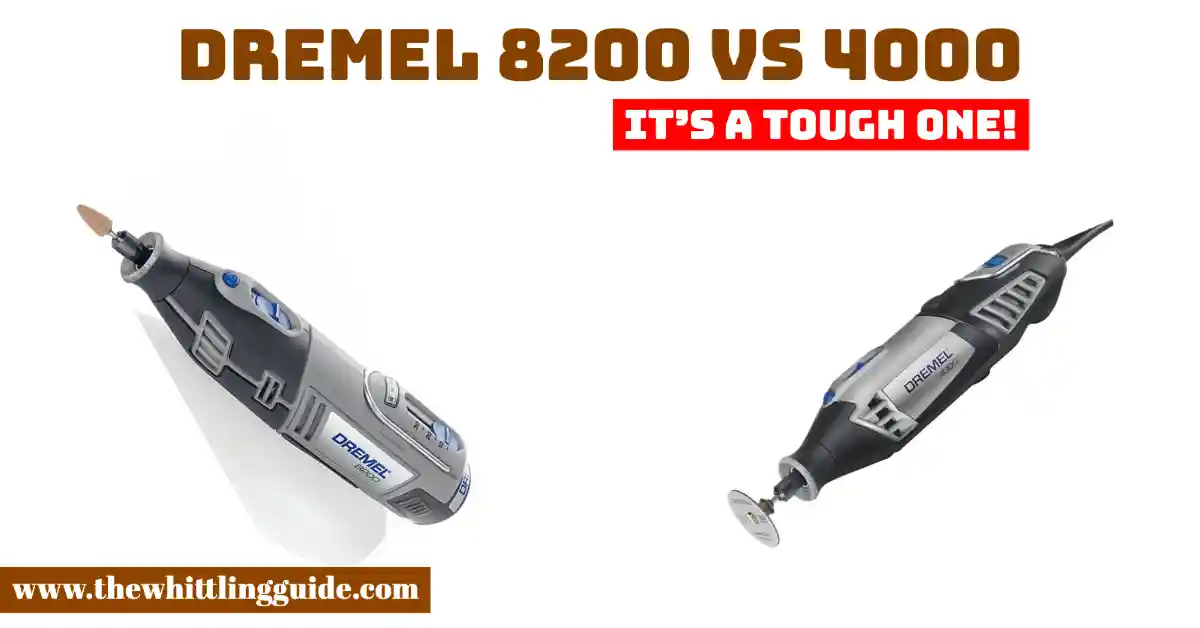
Side-by-side comparison

Dremel 8200 vs Dremel 4000: The Definitive Corded vs Cordless Verdict

Option A Dremel 8200
vs
Option B Dremel 4000: The Definitive Corded vs Cordless Verdict
Dremel 8200 vs 4000 _ It's A Tough One!-1
Read Full breakdown Jump Final verdict Browse More comparisons

How to use this comparison

Dremel 8200

Scan this side when you care about its standout strengths, trade-offs, price, and use-case fit.

Dremel 4000: The Definitive Corded vs Cordless Verdict

Use this side to judge the alternative against the same decision points before reading the verdict.

The Dremel 8200 versus the Dremel 4000 is one of those comparisons that sounds simple until you start digging into the details. On the surface, it looks like a straight cordless-vs-corded fight. In practice, it is a question about how you work — your workspace, your projects, your grip stamina, and how long a job typically runs. Get it wrong and you will spend your time either hunting for a power outlet or swapping out a flat battery mid-cut.

This guide draws on the official operating manuals for both tools, multiple hands-on video reviews, and Dremel’s own FAQ documentation to give you the most accurate, specific comparison available. Let’s get into it.


Quick-Reference Spec Table

SpecificationDremel 8200Dremel 4000
Power sourceCordless — 10.8 V (12V Max) Li-ionCorded — 120 V AC mains
No-load speed range5,000–30,000 RPM5,000–35,000 RPM
Speed controlVariable slide switch (out of grip zone)Variable dial (separate from on/off)
Weight (tool only)~680 g (approx. 24 oz)~510 g (approx. 18 oz)
Collet sizes accepted1/32″, 1/16″, 3/32″, 1/8″ (0.8–3.2 mm)1/32″, 1/16″, 3/32″, 1/8″ (0.8–3.2 mm)
Motor brushesNot user-replaceableUser-replaceable (check every 30 hrs)
Charger (included)Model 876 — 1-hour fast chargerN/A — corded
Stall protectionYes — built-in motor protectionElectronic feedback circuit
Battery fuel gaugeYes — 3-LED indicatorN/A
Warranty2 years2 years
CompatibilityAll Dremel accessories + high-performance attachments (Planer, Multi-Saw)All Dremel accessories and attachments

The One Thing That Actually Decides This Choice

Before we break down every feature, be clear on this: the Dremel 8200 is cordless and tops out at 30,000 RPM. The Dremel 4000 is corded and tops out at 35,000 RPM. That RPM gap matters for certain applications — specifically very fine engraving on hard materials and high-speed cutting where surface speed is critical — but for most woodcarving, sanding, polishing, and detail work, both tools operate in a range where the difference is essentially imperceptible.

What is perceptible is whether you can move freely around your project without a power cord pulling back on your wrist. That freedom defines the 8200. The 4000’s advantage is that you never wait for it, never watch a battery gauge tick down, and never modulate your pressure wondering whether you should conserve charge.

According to Dremel’s own FAQ documentation, the 8200’s performance was designed to be the cordless equivalent of the corded 4000 — same attachment compatibility, same accessory range, comparable real-world cutting ability. That is the design brief in one sentence.


Dremel 8200: In-Depth

Battery, Runtime, and the Charger That Matters

The 8200 runs on a 10.8 V (marketed as 12V Max) lithium-ion battery pack. The included Model 876 charger is a genuine 1-hour fast charger — at the time of its 2009 launch, Dremel stated it was three times faster than any charger they had previously offered. In practice, reviewers testing the tool on demanding tasks (steel cutting, drywall work) reported roughly 30–45 minutes of continuous runtime from a full charge. For lighter applications — sanding, polishing, soft wood carving — the same battery stretched to closer to 3 hours. That is a wide range, and it matters: if your typical session is 20 minutes of detail carving on basswood, you will rarely feel the battery limitation. If you are grinding rust off ironwork for an hour straight, you need a second battery.

The 8200 kit comes in two configurations. The 8200-1/28 includes one battery, the cutting guide attachment, and 28 accessories. The 8200-2/28 adds a second battery and swaps in a right-angle attachment alongside the cutting guide. If you plan to use this tool heavily, the two-battery kit is worth the extra cost — the charger is fast, but not instant.

One point from the official manual worth knowing: the lithium-ion cells in the 8200 must stay between 0°C and 45°C (32°F and 113°F) to charge properly. The charger will not fast-charge a battery that is hot from recent use. After a demanding session, give it 10–15 minutes to cool before plugging in.

The Stall Protection System

The 8200 includes a built-in stall protection circuit that cuts power to the motor and battery when the tool bogs down under excessive load. This is not just a safety feature — it is a battery preservation mechanism. Running a cordless motor through a prolonged stall is one of the fastest ways to kill lithium-ion cells. The stall protection engages automatically, protecting both the motor and the battery pack from damage.

Speed Control Placement

The 8200’s variable speed control is a slide switch positioned out of the natural grip zone. Brian Bennis, Dremel’s product manager at the time of launch, specifically called this out as a deliberate design choice: users can adjust speed on the fly while the tool is running, without changing their grip or shutting down. This is genuinely useful for carvers who move between material types mid-project — you can drop from 25,000 RPM on hardwood to 10,000 RPM when transitioning to a softer area without breaking concentration.

The EZ Twist Nose Cap

The 8200 includes the EZ Twist nose cap, which allows accessory changes without a separate wrench in most cases — you loosen the collet nut by hand using the nose cap. The collet lock mechanism engages the output shaft in eight separate locations for positive locking during bit changes. The included collets accommodate shank sizes from 1/32″ to 1/8″ (0.8 mm to 3.2 mm), covering virtually all Dremel accessories.

Weight and Balance

At approximately 680 g (24 oz) with battery installed, the 8200 is noticeably heavier than the corded 4000. Professional carver reviews consistently note that this weight becomes fatiguing during extended fine-detail sessions — particularly when holding the tool like a pen for engraving. The tool’s weight distribution is well-balanced (the battery sits in the rear body rather than the nose), which helps, but the absolute mass is a real consideration for anyone whose work involves sustained overhead or awkward-angle cutting.


Dremel 4000: In-Depth

The Motor and What “Electronic Feedback” Actually Means

The 4000’s electronic feedback circuit is one of its most practically useful features, and it deserves a proper explanation. When you apply pressure to a rotating accessory — say, pushing a carbide cutter into hardwood — the motor load increases and RPM naturally wants to drop. The electronic feedback circuit detects this drop and automatically increases power to maintain the set speed. In real terms: the RPM you dial in is the RPM you get, even under moderate load. This consistency is what makes the 4000 a reliable tool for repeatable cuts and controlled engraving passes.

The Dremel 3000, by contrast, lacks this circuit. Reviewers who have tested both confirm that the 3000 will slow noticeably when you lean into it, while the 4000 holds its line. For a whittler or carver doing fine relief work, that difference translates directly into cut quality.

Replaceable Motor Brushes: The Long-Game Advantage

The 4000 uses replaceable carbon motor brushes — a feature that significantly extends the tool’s working life and is entirely absent from the 8200. According to Dremel’s official guidance, these brushes typically last between 50 and 100 hours depending on usage intensity, and you should check them every 30 hours. The inspection process is straightforward: use the flat end of the included wrench to unscrew the access cap near the Dremel logo. If the carbon piece measures less than 1/8″ (about 3 mm), both brushes need replacing.

This matters for long-term cost of ownership. A set of replacement brushes costs a few pounds/dollars and extends the motor’s life. The 8200, having a sealed motor without user-serviceable brushes, relies on the motor lasting indefinitely — which it typically does under normal use, but provides no maintenance pathway if the motor degrades.

Speed Range and the 35,000 RPM Ceiling

The 4000 reaches 35,000 RPM — 5,000 RPM higher than the 8200’s 30,000 RPM maximum. For most everyday applications, this difference is irrelevant. Where it starts to matter is very fine engraving on glass or ceramics, where diamond wheel points benefit from maximum surface speed, and in thin cutting wheel applications where higher RPM improves cut quality and reduces chip-out.

The 4000’s speed dial is separated from the on/off switch — a design decision that allows you to set your working speed before you start, and return to that exact setting after turning the tool off. This is more useful than it sounds during a session where you might switch the tool off repeatedly between cuts.

Attachments and the Flex Shaft

Both tools accept the full range of Dremel attachments, but the 4000 is particularly well-suited to the Dremel Flex Shaft attachment (model 225). With the flex shaft installed, you hang the 4000’s motor body from its integrated metal hook and work with only the lightweight flexible handpiece — effectively reducing the weight in your hand to almost nothing. For woodcarvers doing intricate relief work or whittlers finishing small figures, this is genuinely transformative. The flex shaft allows a pencil-grip precision that is simply not achievable when holding the full motor body.

The 8200 is technically compatible with the flex shaft, but the cordless form factor makes it far less practical to hang and use in this way. The 4000 is, in this respect, the better dedicated carving tool when used with attachments.

Practical Runtime: The Underappreciated Advantage

A corded tool does not have runtime. You plug it in and it works until the job is done. For sessions longer than 45 minutes of continuous use — or projects requiring repeated high-load cuts — this is a meaningful advantage. There is no battery management, no charger wait, no mid-project interruption. For workshop use where an outlet is always within reach, this reliability is the 4000’s strongest selling point.


What Both Tools Share

It is worth being explicit about what these two tools have in common, because the list is long:

  • Full accessory compatibility: Both accept all Dremel accessories with 1/8″ shanks as standard, and both work with smaller shanks using the separately purchasable collet set (#4485) or the keyless chuck (#4486).
  • EZ Twist nose cap system for wrench-free accessory changes in most situations.
  • Collet lock in eight positions for positive bit engagement.
  • Variable speed from 5,000 RPM — both start at the same low-speed floor, which is essential for heat-sensitive materials and delicate surface work.
  • 2-year manufacturer’s warranty.
  • The same accessories charts in their respective manuals — recommended speed settings by material and accessory type are essentially identical, confirming that the two tools are designed for the same range of tasks.

Real-World Battery Life vs Cord Freedom: The Trade-off Explained

The 8200’s battery performance breaks down roughly as follows based on consistent reports across multiple independent reviews:

  • Demanding use (steel cutting, dense hardwood, drywall): approximately 30–45 minutes per charge
  • Medium use (soft wood carving, engraving, routing): approximately 1–1.5 hours per charge
  • Light use (sanding, polishing, surface finishing): approximately 2.5–3 hours per charge

The 1-hour charger means you are rarely more than an hour away from a full battery even if you run it flat. For most hobbyist carving and whittling sessions — which typically run 30–90 minutes — a single charge covers the work comfortably.

The cord on the 4000, meanwhile, is approximately 6 feet (roughly 1.8 metres) long. In a typical home workshop, that is enough to reach your bench from a wall outlet without an extension cord. On location, in a garden, or anywhere without a convenient socket, the 8200 is the only practical option.


The Collet System: What You Need to Know Before You Buy Accessories

Both tools come standard with a 1/8″ (3.2 mm) collet, which fits the vast majority of Dremel accessories. If you plan to use smaller accessories — fine engraving bits, small drill bits, or detail carving burrs with 3/32″, 1/16″, or 1/32″ shanks — you will need to purchase additional collets separately (Dremel #481, #482, #483 individually, or the full set as #4485). Alternatively, the Dremel keyless chuck (#4486) accepts any shank size without needing dedicated collets, which is a worthwhile upgrade for carvers who use a wide variety of bits.


Which Tool is Right for Whittling and Wood Carving?

Since this is a whittling and woodcraft site, it is worth being specific rather than generic.

For carving in the shop or at a fixed bench: The 4000 with the flex shaft attachment is the better carving tool. The flex shaft reduces fatigue dramatically on long sessions, the 4000’s electronic feedback keeps cuts consistent, and the replaceable brushes mean the tool is built to last through years of regular use. This is the setup that most dedicated Dremel carvers gravitate toward.

For carving on location — at a club, on a course, outdoors, or in a space without reliable power: The 8200 is the obvious answer. The freedom of movement it provides when working in the round or rotating a piece is genuinely useful, and the 30,000 RPM ceiling is more than adequate for all wood carving applications including basswood, butternut, and softer hardwoods.

For beginners setting up their first kit: The 4000’s lower price, corded reliability, and user-replaceable motor brushes make it the safer long-term investment. You will never open it and find a flat battery. It will work exactly the same on day one as on day three hundred.

Recommended Speed Settings for Wood Carving (Both Tools)

The official Dremel speed charts — which appear in identical form in both the 8200 and 4000 manuals — give the following guidance for wood applications:

  • High-speed steel cutters on softwood: Settings 7–10 (approximately 25,000–30,000 RPM)
  • Tungsten carbide cutters on hardwood: Settings 6–8 (approximately 20,000–25,000 RPM)
  • Sanding bands and discs on wood: Settings 6–9
  • Engraving bits on wood: Settings 5–6 (approximately 15,000–20,000 RPM) to avoid burning

One consistent caution in the manuals: on deep grooves in any wood, burning becomes a risk at high speeds. Start lower than you think you need to and increase gradually.


Frequently Asked Questions

Is the Dremel 8200 discontinued?

The 8200 has been largely superseded in Dremel’s current cordless lineup by the 8220 and 8260. However, the 8200 still circulates widely on the secondhand market and in remaining retail stock, and its battery and charger are interchangeable with other 10.8 V Dremel cordless tools. Accessories are fully compatible with all current Dremel rotary tools.

Can the Dremel 8200 use all the same attachments as the 4000?

Yes. According to Dremel’s official product documentation, the 8200 is the only cordless rotary tool Dremel made that can run all Dremel accessories and attachments — including the high-performance Multi-Saw and Planer attachments previously reserved for corded tools only. The 4000 shares this full compatibility.

Which is heavier, the 8200 or 4000?

The 8200 is heavier. With battery, it weighs approximately 680 g (24 oz). The 4000 weighs approximately 510 g (18 oz). For long carving sessions or sustained overhead work, the 170 g (6 oz) difference is noticeable.

Does the Dremel 4000 work with the flex shaft?

Yes, and it is one of the 4000’s most recommended accessories for carvers. The flex shaft (model 225) is widely considered the best way to use any Dremel for prolonged fine wood carving, because it dramatically reduces the weight in your hand.

What is the difference between the 8200 and the newer 8220?

The 8220 is Dremel’s updated cordless model with a 12V Max battery and a top speed of 30,000 RPM — essentially replacing the 8200 in the current lineup with largely comparable performance. If you are buying new, the 8220 is the current cordless alternative to the 4000. If you encounter the 8200 at a lower price secondhand, it performs comparably.


The Verdict

The Dremel 4000 is the better tool for most woodcarvers and whittlers working from a fixed space. It is lighter, reaches a higher top RPM, has a replaceable motor brush system that extends its working life, and becomes genuinely outstanding when paired with the flex shaft attachment. For workshop use where a power outlet is available, it is the more practical, more durable choice over the long term.

The Dremel 8200 wins when location matters. If you work outside a fixed shop, travel to carving sessions, or simply do not want a cord trailing across your workbench, the 8200 (or its successor, the 8220) delivers fully comparable performance for the majority of carving and woodcraft applications. The 1-hour charger keeps downtime to a minimum, and the battery longevity is genuinely reasonable for the hobby use-cases most readers of this site will have.

Both carry Dremel’s 2-year warranty, both accept the complete range of Dremel accessories, and both are built to a standard that justifies the price. The decision, at its core, is this: do you need to move freely, or do you need to work indefinitely? Answer that honestly and you have your tool.

Still comparing? Find my tool

Leave a Reply