Overview
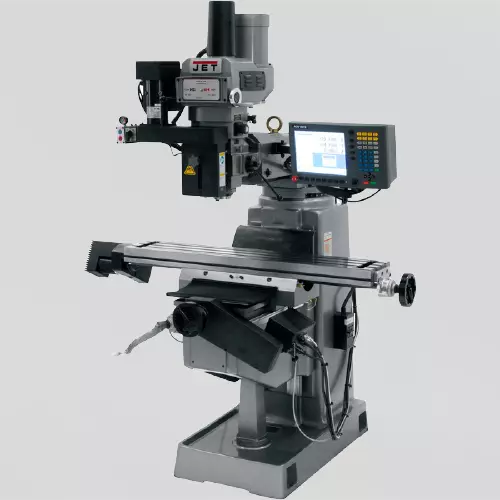
The JET Mill is a milling machine with a variable speed. The JET Mill has a 3-Axis Acu-Rite G-2 Millpwr CNC, featuring a computer numerical control system that gives the added precision of digital automation to the process. Less human effort is required when it comes to digitalization.
A milling machine is a vertical cast mill with a complete, factory-installed CNC package with 3-axis CNC controls that deliver accurate results every time. It allows the user greater control and efficiency. It comes with a 2-year limited warranty and is adequate to match your specifications.
Key features
Ground ball screws
Precision ground ball screws eliminate backlash for precise lateral movements. It is a high-efficiency feed screw with the ball making a rolling motion between the screw axis and the nut. This milling has a drive torque of one-third or less, making it suitable for saving drive motor power.
Closed-loop feedback
Closed-loop Systems use feedback where a portion of the output signal is fed back to the input, reducing errors and improving stability systems. The output quantity does not affect the input to the control process. The feedback uses Acu-Rite precision linear encoders with 0.00005inch resolution.
Power
The milling machine features Powerful DC Servo motor assemblies that include mounting castings and hardware and operates at speeds greater than 2000 rpm. Servo motors have high torque and are ideal for high-speed and high torque applications involving dynamic load changes.
Operation
As much as the milling machine is automated, you can still use handwheels, allowing you to run a manual operation.
ACU-RITE MILLPWR G2 CONTROLLER
The ACU-RITE MILLPWR G2 CONTROLLER is USB and Ethernet compatible, and the controller provides simplified navigation that eliminates multiple menu screens. One screen makes the operation visible and easy to follow.
The 12.1inch high-resolution display (1024 x 768) on the controller features 3D graphics, and you have access to the whole side of the design. It allows you to work with detail as the display gives you a program preview with a graphical representation before operation.
The menu-prompted conversational programming helps to create part programs. The programs are edit, reverse, change, delete and copy or move steps, follow the menu prompts, and let MILLPWR G2 do the rest. The program size limit is increased by 90% to 9,999 steps.
Jog control
The jog control feature allows table movement. That is from one location to another and uses one axis or two axes. The JOG control is also called jogging mode, which allows the CNC machine to operate manually. The CNC machine becomes faster, and the CNC machine carriage can travel.
CAD/CAM programs
The 3D contouring offers the ability to import and run G-code files from CAD/CAM programs. It comes with a Rotate function that easily manipulates, explodes, and merges partial programs to save time and reduce program steps.
Built-in Calculator
A built-in calculator performs standard, trig, and geometry calculations and transfers them directly into part programs. Do not buy an additional calculator.
Pockets
Custom pockets and islands utilize the new optimized path and ramp feed features. The circles include the Pocket, Frame, Ring, and Helix have the new ramp feed feature.
Technical Specification
Manufacturer’s Warranty
It comes with 24 months parts / 24 months labor. A technical problem that you encounter within twelve months, you have the right to send it back for repair or fixing, ensuring you of a well-functioning milling machine for a long time.
Horsepower
The 3HP motor design is an NC milling machine for metal processing. Its guideway has the characteristics of high rigidity, high wear resistance.
Speed (RPM)
The milling machine has a speed variance of 60–4,200 rpm. The cutting speed and feed determine the surface finish, power requirements, and material removal rate. What determines the feed and speed is the material. Consider the tool material, rigidity of the workpiece, size and condition of the lathe, and depth of cut when choosing speed.
Vertical Stroke
The vertical stroke is 5 inches, and the milling cutter in vertical milling machines is flexible and has a wide range of applications.
Stand
The Stand gives stability and rigidity to the working machine. The chances are low that it will move during operation. That is how precision comes to your items.
Aesthetics
Colour
The Jet mill comes in standard color. The environment determines the colors in the milling machine. There are chances whereby the milling machine gets in contact with oil and other sharp items. The standard color is black paint with high bitumen content. It provides a protective finish that is durable and dries quickly.
Size
A milling machine is a heavy-duty machine meant to work on metal and other heavy materials. That makes it an ideal machine for the industries.
Uses
- Milling
- Cutting
- Drilling
Pros
- Speed variance
- Display
- Versatility
- Heavy duty
- Precision
- Efficiency
Cons
- Heavy
- No light
Price
Comparing the Jet milling machine with CNC machines, it is affordable. Even beginners and hobbyists can find it easy to budget money to buy the milling machine. Buy some accessories as you go to have a hybrid milling machine. The price is worth the milling machine. It comes with advanced features that make it worth the price, including the built-in calculator and the display.
Verdict
Natter what stage you are in the metalwork industry, buying the JET Mill with 3-Axis Acu-Rite G-2 Millpwr CNC can be the best thing you have ever done for your project. The JET Mill is a milling machine is a speed variant machine with the added precision of digital automation of the process, greater control, and efficiency. The milling machine is already installed and delivers accurate results every time. It comes with a 2-year limited warranty and is custom-made to match your specifications. The only drawback is that it does not come with a light. Considering the above factors, compare the features with your expectations and set your priorities before deciding.

- Grain and Sheen: Teak Oil versus Danish Oil Uncovered - January 10, 2024
- The Cherry on Top: Crafting the Perfect Cutting Board - January 9, 2024
- Polyurethane Water-Based vs Oil-Based: Choosing the Right Finish - January 8, 2024

