Overview
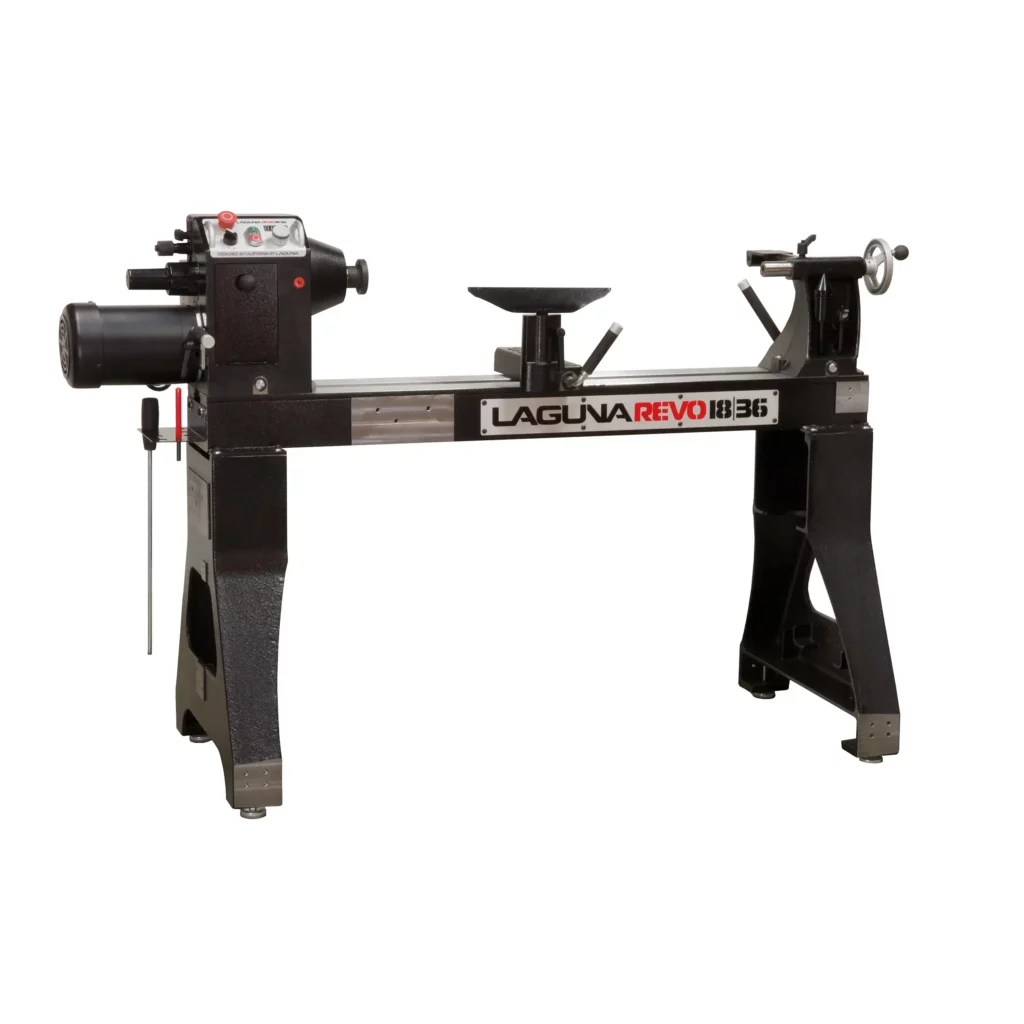
Laguna Revo 1836 is a new version of the Laguna family lathe that features a 2HP motor, variable speed control, and many more features for both bowl and spindle work. The smooth run is due to a fully cast-iron design of the headstock.
It has a ground, solid steel bed. The cast-iron tool rest has simple control, and the induction motor comes with VFD offering high torque. The digital readout for speed setting is in two gears from 50 to 3500 rpm, with the spindle indexing at 14, 36, and 48 positions.
The height has adjustable legs for a simple setup and can be fitted with a telescopic wheel system for moving. Below is a detailed review of the lathe tool that you can compare with your list of preferences.
Specifications
Power
Its power delivery is unbeatable. It is a quiet, smooth-running motor and variable speed control. The Laguna tool is a high-quality, advanced system that accepts single-phase 220V power, and converts it to three-phase using a Variable Frequency Drive (VFD). That takes place before delivering it to the 2 HP motor. A variable frequency drive (VFD) is a type of motor controller that drives an electric motor by varying the frequency and voltage of its power supply (Danfoss.com).
Three-phase power provides a smoother running system across a range of speeds by controlling the power level at the motor, without the need for belt changes for each speed adjustment.
It maintains smooth transitions from low to high speed and steady operation with high torque at any selected speed. That is how you can impart a chatter-free sheer on your workpiece.
The power delivery system also senses resistance and compensates by delivering more power to maintain the desired RPM level. That makes it more advanced.
That is helpful when operating in the lower speed range while roughing out large bowls. When a green bowl blank is first mounted, it becomes difficult to maintain a slow RPM. Choose a speed, at which the blank can be rounded and brought into balance. When operating in a slow speed range, 1836 stands out in its ability to maintain its speed and avoid stalls.
Speed control
1836 provides variable speed within each of two ranges. There is a simple belt change from the low-speed range (50 – 1300 RPM) to the high-speed range (135 – 3500 RPM). Each power range has speed variance with intuitive dial control.
Use low range for bowls and other projects. It is easier to work within the 50 – 1300 RPM range without a belt change. Chances are higher that you can do most of your spindle work within that range. However, for turners who like to crank up the speed for spindles.
Laguna Revo 1826 is for high-speed action. It still performs better on spindle pieces with the lathe configured in the high range. It comes with smooth acceleration and stability at any RPM.
Dial up the RPM to a speed for shaping operations without stopping the machine. You no longer have to disrupt your turning to swap belts for every speed change on the lathe.
Control panel
The control panel is user-friendly. It is aluminium, and the control panel is at a neutral height and a convenient angle. That gives you easy access and viewing of the large format digital RPM readout.
Buttons and dials are large, colored, and provide smooth operation. A large digital display indicates the actual spindle speed with real-time updates. That explains how one gets to appreciate the thoughtful ergonomics of this design.
Features
Reverse setting
The reverse setting is convenient on a lathe. It makes the lathe handy for sanding projects. Flip the switch to change directions, and you can safely apply sandpaper to the top of the spinning object for better control and visibility, and direct sanding dust right down the gullet of your dust capture system. When the machine is at the right depth, it flicks the motor into reverse (MIG-welding).
Frame
The bed in 1836 is steel construction, unlike Jet lathes made of cast iron. Steel brings stability to the design. Its surface is polished smooth so that the banjo travels on it with low-friction ease.
The lathe sits on a pair of cast iron legs that absorb vibration and provide stability when turning large bowls. That gives you comfort when operating. The frame is strong enough to accommodate the onboard storage.
Onboard storage
The Laguna Revo 1836 package includes convenient onboard storage. It helps you keep track of the accessories that you will use. Your equipment is less likely to get damaged.
Tool rest
The standard tool rest that comes with the Laguna Revo 1836 is outstanding. It is a solid performing, durable component amongst other accessories. The 6mm spring steel tip provides a solid, ergonomic balance point for controlling chisels during turning operations.
There is no need to upgrade to an after-market tool rest as this model serve for decades. What makes it a detailed tool is the mechanism that locks the tool’s rest into position.
The lever locks a collar that wraps around the perimeter of the tool rest post, applying even pressure that does not affect the post’s surface or alter its ability to slide. The lever holds it solidly under pressure.
Headstock
The Laguna lathe has a conical shape of the headstock that extends the workpiece outward. While tapering back, gives the user better access to bowl bottoms without removing the workpiece from the lathe. That is beneficial with using chisels and provides access during sanding as well.
Live center and tailstock
The live center is robust and effective at holding large workpieces steady during aggressive turning. Even when turning a spindle that spanned the entire 56inch capacity, the rotation remains smooth and steady.
The tailstock is substantial, giving smooth adjustability, and the tailstock quill has ample 4-1/2inch travel with a solid locking mechanism. The quill has details like laser-etched measurements that do not fade through years of use, and a brass-tipped locking mechanism that will not mar the quill as it locks it into position.
Bed extension
The 1836 functions well on bowl and spindle work, and the optional bed extension brings the additional capacity for both types of work. The extension adds a 20inch of additional length capacity for spindle work, and the step-down design gives bowl turners 7inch of clearance between the spindle and the bed. That allows for the turning of bowls up to 32inch.
The bed extension also comes with a tool rest height extension to enable placement of the banjo and tool rest on the bed extension, which is 7inch lower than the bed.
Mobile base
1836 is a big machine, not ideal for a small shop. There is a need to move it around the shop. That is where the mobile base is domestic. It provides large wheels on each corner of the lathe machine, and balanced dual gas struts raising and lowering a smooth experience. The mobile base features large urethane wheels that allow you to move the lathe machine around your shop with one hand.
Ergonomics
1836 is a well-designed machine with adjustment levers with padded grip areas. They lock down easily and securely. The positioning of the locking mechanisms for both headstock and tailstock on the rear of the machine. That way, it does not interfere with chisel placement during turning operations.
The banjo and tailstock are easy to re-position, sliding smoothly on the polished steel bed. The machine also includes a neat mechanism to adjust the tailstock if it is not in alignment with the headstock.
Verdict
If you are looking for stability, quality and robustness, the Laguna Revo 1836 might be your tool. It is ideal for specialists and woodturning professionals in small and medium-sized woodshops. It features an ergonomic control panel for speed control. The bed is solid, and there is minimum vibration due to the legs. With these features, you might be curious to explore more with the tool or have a better version that you still want to look for.
Resources and Documentation

- Grain and Sheen: Teak Oil versus Danish Oil Uncovered - January 10, 2024
- The Cherry on Top: Crafting the Perfect Cutting Board - January 9, 2024
- Polyurethane Water-Based vs Oil-Based: Choosing the Right Finish - January 8, 2024
